
For this project, I set out to get some real-world copywriting experience to add to my portfolio. I also dissected a successful email campaign and used what I learned to make my own email mockups, and created a brand guide to further grow my marketing/operations skills. Below you’ll find the links to all of my documentation and completed projects. Enjoy!
Why I Chose This Project
As an avid lover of writing, the idea of copywriting has piqued my interest. Copywriting comes in a variety of forms- short-form, long-form, sales copy, content creation. Sky’s the limit with the words that go into selling a product.
To get real-world experience in copywriting
For this reason, I chose diving into copywriting. Email copy, to be specific. It is a crucial part of business, no matter what role you operate in. I chose two projects geared specifically toward this skill set.
I sought after an outsourced project because I believe the best way to learn is by doing. Fulfilling a project for a client required me to take on their company’s lingo, tone, and attitude in my writing. Not only that, but what he wanted mattered more than what I wanted, and what he thought was good is what mattered.
To learn the operations side of marketing
For my final deliverable, I decided on a project that would test both my marketing and operation skills: a brand guide.
A brand guide is what unites a business. It is the color theme, the logos, the lingo, and sets the tone of all communications.
I built this month’s project with the goal of building my copywriting, marketing, and operations skillset.
Weekly Updates:
Week 1 — The Planning Phase
- This was all about planning and prep. During the week I chose a project theme, networked and got myself a real-world copywriting project, brainstormed my desired project deliverables, formulated a plan, and built my task management system.
Week 2 — The Test Phase
- In week two, I dove into my first email sequence creation. I documented my research and thought process behind each piece.
- I read Ogilvy on Advertising every day and posted a quote on Twitter.
- With big projects comes the need for management. I posted a blog on how I utilized Trello to manage this project.
Week 3 — The Hustle Phase
- Week three, I created my second email sequence for Evernest and documented my thought process.
- I finished reading Ogilvy on Advertising and crafted an outline for my blog
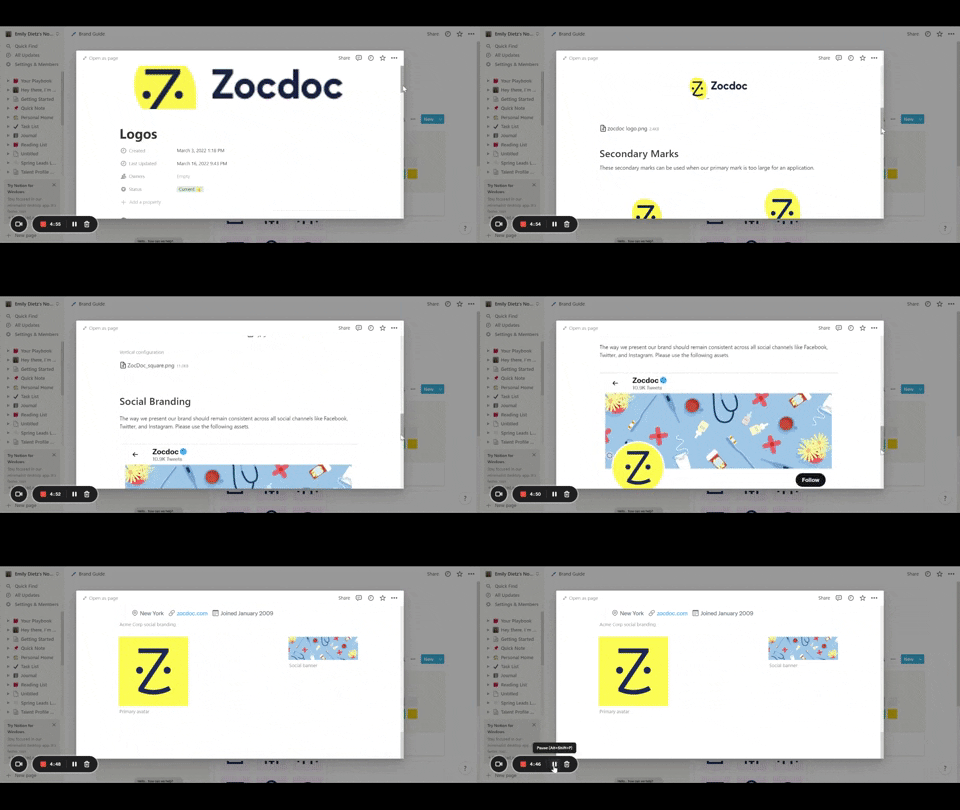
- By using Notion, I build a mock-up brand guide for Zocdoc and documented my learning process.
Week 4 — The Final Stretch
- Week four was all about reengineering a newsletter that I personally enjoy, and creating mockups of my own. I also created videos displaying my knowledge of Mailchimp and Canva as a supplement.
- I finished my Ogilvy on Advertising blog post.
- Finished my landing page and put the finishing touches on my project.

Blog Posts:
Writing an Email Sequence Template to Boost Webinar Attendance
How (and Why) I’m Using Trello to Manage My Month-Long Project
Writing a Second Email Sequence for Evernest
Creating a Brand Guide by Using Notion
Breaking Down a Newsletter to Determine Why it Works and Then Creating My Own
Why Ogilvy on Advertising is Regarded So Highly by Wanna-Be Copywriters and Successful Copywriters Alike
What I Learned:
This project taught me how to plan and manage my own project within a set time frame. This came with many hurdles. I had to brainstorm each project and determine whether or not it could be accomplished within the timeframe that I needed it to be. I also had to coordinate with a third party to complete projects for them. It really tested my time management skills and taught me how to keep myself accountable. I had to be flexible, yet stay firm with my planning in order to get it done.
This project was all about marketing, with an emphasis on improving my copywriting skills. I learned how to use Mailchimp, which I’d never used before and is a popular means for email marketing.
By creating a brand guide, I had to figure out the innerworkings and voice of a company the best way I could.
When I took on outsourced email writing projects, not only did I learn the best methods for webinar email sequences, but how to write in a voice that matched the company I was writing for.
What I’d Do Differently:
With every project, there’s always something we wished we knew before we started. That being said, if I were to change anything about this project, it would be:
- Creating a client profile for my brand bible. I think that could have been a really useful addition. Customer profiles give employees a fundamental and clear picture of who they are writing to.
- Spending more time cultivating my newsletter and experimenting with Mailchimp. For the sake of time, I stuck with the very basic version of what I wanted the newsletter to look like, but I could have tried out different formats and potentially found one that was superior.
- Moved all of my drafts into Medium sooner. I wrote everything out in Google Doc, so the formatting appears very differently for some pieces. I should have moved them after each week and made formatting them to Medium apart of the weekly goals instead of trying to do it all at the end.
This project was a very satisfying one. The ability to fully plan out and execute a project of my own design was fulfilling. I learned things about marketing and about myself.
 Emily Dietz
Leave a comment